The Complete List of Pulitzer Prize Fiction Winners


The Pulitzer Prize for Fiction has been awarded to numerous books since 1918, and this page lists every winner in order, from the earliest recipients through the most recent. The 2026 prize went to Daniel Kraus for Angel Down, a genre-blending World War I novel. It follows Percival Everett’s 2025 win for James and Jayne Anne Phillips’s 2024 win for Night Watch. Below, you’ll find the full chronology, a decade-by-decade digest, notable records, and how the prize actually works.
TL;DR:
- The 2026 winner, Angel Down, blends World War I history with horror and speculative fiction, breaking from traditional literary winners.
- Recent winners like James and Night Watch highlight the jury’s preference for daring narrative structures and deep historical characterizations.
- The Pulitzer often favors historical fiction and experimental forms, with structural risks like Trust and The Overstory receiving critical acclaim.
- Four authors, including Colson Whitehead, have won twice, with Whitehead’s consecutive wins in 2017 and 2020 making him the most decorated in recent history.
- Prize decisions are made through a jury shortlist, but the full board can decline to award the prize or select a different winner, especially in no award years.
Table of Contents
- Pulitzer Prize Fiction Winners by Year, Most Recent First
- The Last 10 Pulitzer Prize Winners, Ranked by Year
- Repeat Winners and Other Records Worth Knowing
- How the Fiction Prize Actually Gets Decided
- Notable Winners and the Themes They Explore
- How the Pulitzer Compares to the National Book Award and the Booker Prize
- Where to Verify Every Winner and Finalist
- Where to Start If This List Feels Overwhelming
- Sources
Pulitzer Prize Fiction Winners by Year, Most Recent First
Scanning Pulitzer Prize novels by year turns up patterns you won’t notice reading them one at a time. War novels cluster in certain decades. Historical fiction dominates some years and vanishes in others. Short story collections, which weren’t eligible until 1948, have quietly racked up an impressive tally since.
Here is the full run, organized so you can find any specific year fast.
2026 to 2020
- 2026 — Angel Down by Daniel Kraus. A genre-crossing World War I novel that blends historical fiction with horror and speculative elements.
- 2025 — James by Percival Everett. A reimagining of Adventures of Huckleberry Finn told from Jim’s perspective, awarded the prize for its formal daring and moral clarity.
- 2024 — Night Watch by Jayne Anne Phillips. A Civil War era novel set in a West Virginia asylum, tracing a mother and daughter separated by the war’s aftermath.
- 2023 — Trust by Hernan Diaz. A four-part novel about a Wall Street fortune, told through competing and contradictory versions of the same story.
- 2022 — The Netanyahus by Joshua Cohen. A campus satire fusing a fictional 1950s academic visit with real family history tied to the Netanyahu name.
- 2021 — The Night Watchman by Louise Erdrich. Based on Erdrich’s grandfather’s fight against a 1950s federal termination policy targeting Native American tribes.
- 2020 — The Nickel Boys by Colson Whitehead. A brutal, spare account of two boys at a reform school modeled on a real Florida institution known for decades of abuse.
2019 to 2010
- 2019 — The Overstory by Richard Powers. Nine strangers whose lives intersect through their relationship to trees, structured like a forest’s own branching root system.
- 2018 — Less by Andrew Sean Greer. A comic novel following a struggling novelist who accepts a string of dubious literary invitations to dodge his ex’s wedding.
- 2017 — The Underground Railroad by Colson Whitehead. Reimagines the Underground Railroad as a literal rail system, following an enslaved woman’s escape through the antebellum South.
- 2016 — The Sympathizer by Viet Thanh Nguyen. A double-agent narrator bridges the Vietnam War and its refugee aftermath in a debut that won on its first attempt.
- 2015 — All the Light We Cannot See by Anthony Doerr. Parallel stories of a blind French girl and a German soldier converge during the World War II siege of Saint-Malo.
- 2014 — The Goldfinch by Donna Tartt. A boy who survives a museum bombing carries a stolen painting through decades of grief, addiction, and art-world intrigue.
- 2013 — The Orphan Master’s Son by Adam Johnson. A North Korean protagonist’s journey through his country’s propaganda machine and prison camps.
- 2012 — No award given. The jury forwarded three finalists, but the board could not reach the required majority.
- 2011 — A Visit from the Goon Squad by Jennifer Egan. A fractured, time-jumping novel about the music industry, told through interlinked characters and one chapter written as a PowerPoint presentation.
- 2010 — Tinkers by Paul Harding. A dying clock repairman’s memories interweave with his father’s, published by a small press after major houses passed on it.
2009 to 2000
- 2009 — Olive Kitteridge by Elizabeth Strout. A linked story collection centered on a retired schoolteacher in coastal Maine.
- 2008 — The Brief Wondrous Life of Oscar Wao by Junot Díaz. A Dominican American coming-of-age story that folds in family curses, dictatorship history, and comic-book references.
- 2007 — The Road by Cormac McCarthy. A father and son walk through a burned-out post-apocalyptic America in one of the starkest novels to win the prize.
- 2006 — March by Geraldine Brooks. Reimagines Little Women through the absent father’s Civil War experience.
- 2005 — Gilead by Marilynne Robinson. A dying minister’s letter to his young son, set in 1950s Iowa.
- 2004 — The Known World by Edward P. Jones. Explores the little-discussed history of Black slaveholders in the antebellum South.
- 2003 — Middlesex by Jeffrey Eugenides. A multigenerational saga tracking an intersex narrator’s Greek American family across the 20th century.
- 2002 — Empire Falls by Richard Russo. A small-town Maine diner manager navigates a dying mill economy and a fractured family.
- 2001 — The Amazing Adventures of Kavalier & Clay by Michael Chabon. Two cousins invent a comic-book superhero against the backdrop of World War II era New York.
- 2000 — Interpreter of Maladies by Jhumpa Lahiri. A debut short story collection following Indian and Indian American characters across continents.
1999 to 1980
- 1999 — The Hours by Michael Cunningham. Three women’s lives intersect across decades, anchored by Virginia Woolf’s Mrs. Dalloway.
- 1998 — American Pastoral by Philip Roth. A former high school football star’s American dream collapses when his daughter becomes a domestic terrorist.
- 1997 — Martin Dressler: The Tale of an American Dreamer by Steven Millhauser. A turn-of-the-century entrepreneur builds increasingly fantastical hotels in New York.
- 1996 — Independence Day by Richard Ford. A divorced real estate agent takes his son on a disastrous road trip over a Fourth of July weekend.
- 1995 — The Stone Diaries by Carol Shields. A fictional biography tracing one woman’s ordinary life from birth to death.
- 1994 — The Shipping News by E. Annie Proulx. A hapless journalist rebuilds his life in a remote Newfoundland fishing village.
- 1993 — A Good Scent from a Strange Mountain by Robert Olen Butler. Vietnamese immigrant stories set in Louisiana, written by a Vietnam War veteran.
- 1992 — A Thousand Acres by Jane Smiley. King Lear transplanted to an Iowa farm family fracturing over inheritance and buried abuse.
- 1991 — Rabbit at Rest by John Updike. The fourth and final novel in Updike’s Rabbit Angstrom series, closing out a life of quiet American discontent.
- 1990 — The Mambo Kings Play Songs of Love by Oscar Hijuelos. Two Cuban musician brothers chase fame in 1950s New York.
- 1989 — Breathing Lessons by Anne Tyler. A single day in a long, imperfect Baltimore marriage.
- 1988 — Beloved by Toni Morrison. A formerly enslaved woman is haunted, literally, by the daughter she killed to spare her from slavery. Widely regarded as one of the most influential Pulitzer-winning novels of the 20th century.
- 1987 — No award given.
- 1986 — Lonesome Dove by Larry McMurtry. An epic cattle drive from Texas to Montana, and the two aging former Texas Rangers who lead it.
- 1985 — Foreign Affairs by Alison Lurie. Two American academics abroad in London find their assumptions about love upended.
- 1984 — Ironweed by William Kennedy. A Depression era drifter confronts the ghosts of his past in Albany, New York.
- 1983 — The Color Purple by Alice Walker. An epistolary novel following a Black woman’s survival and self-discovery in the early 20th century South.
- 1982 — Rabbit Is Rich by John Updike. The third Rabbit novel, following Harry Angstrom into prosperous, restless middle age.
- 1981 — A Confederacy of Dunces by John Kennedy Toole. A comic New Orleans novel published posthumously after the author’s suicide, a decade after he wrote it.
- 1980 — The Executioner’s Song by Norman Mailer. A nonfiction novel reconstructing the case of convicted murderer Gary Gilmore.
1979 and earlier
- 1979 — The Stories of John Cheever by John Cheever.
- 1978 — Elbow Room by James Alan McPherson.
- 1976 — Humboldt’s Gift by Saul Bellow.
- 1975 — The Killer Angels by Michael Shaara, a Civil War novel centered on the Battle of Gettysburg.
- 1973 — The Optimist’s Daughter by Eudora Welty.
- 1972 — Angle of Repose by Wallace Stegner.
- 1970 — The Collected Stories of Jean Stafford by Jean Stafford.
- 1966 — The Collected Stories of Katherine Anne Porter by Katherine Anne Porter.
- 1961 — To Kill a Mockingbird by Harper Lee, one of the best-known and most widely taught novels ever to win the prize.
- 1958 — A Death in the Family by James Agee, published and awarded posthumously.
- 1953 — The Old Man and the Sea by Ernest Hemingway.
- 1940 — The Grapes of Wrath by John Steinbeck.
- 1937 — Gone with the Wind by Margaret Mitchell.
- 1921 — The Age of Innocence by Edith Wharton, the first woman to win the prize in this category.
- 1918 — His Family by Ernest Poole, the first winner when the category launched under the name Novel.
This list is not exhaustive of every year on record. Multiple years, particularly in the 1920s through 1940s, saw the prize withheld entirely, a pattern discussed further below. For the fullest year-by-year detail, the official Fiction winners page and the Library of Congress’s bibliography of winners from 2000 forward both remain the most reliable references for verifying an exact citation or finalist detail.
The Last 10 Pulitzer Prize Winners, Ranked by Year
If you only want the recent Pulitzer Prize winners and a reason each one mattered, this is your shortcut. No need to scroll the full chronology above.
- 2026: Angel Down by Daniel Kraus. A World War I novel that mixes historical realism with horror and genre fiction, an unusual combination for a prize that has historically favored more conventional literary fiction.
- 2025: James by Percival Everett. Retelling Huckleberry Finn from Jim’s point of view, the jury recognized the novel’s reworking of a canonical American text into something formally inventive and morally sharp.
- 2024: Night Watch by Jayne Anne Phillips. A quiet, interior Civil War novel, part of a steady pattern of historical fiction winning in years when the jury favored deep character work over plot mechanics.
- 2023: Trust by Hernan Diaz. Told in four contradictory sections, the novel’s structural ambition over a Wall Street fortune stood out among that year’s finalists.
- 2022: The Netanyahus by Joshua Cohen. A campus satire that folds real political history into fiction, rewarded for its audacity as much as its craft.
- 2021: The Night Watchman by Louise Erdrich. Rooted in Erdrich’s own family history fighting a federal termination policy, this win reflected the jury’s continued attention to Native American narratives.
- 2020: The Nickel Boys by Colson Whitehead. Whitehead’s second win in four years, discussed further below, cemented him as one of the most decorated living authors in the category.
- 2019: The Overstory by Richard Powers. An ambitious, multi-strand novel about trees and human consequence, rewarded partly for its structural risk.
- 2018: Less by Andrew Sean Greer. A rare comic novel to take the prize, proof the jury doesn’t only reward tragedy.
- 2017: The Underground Railroad by Colson Whitehead. Whitehead’s first win, and a book that also took the National Book Award the same year, a rare double.
Looking across this decade, two things stand out: historical fiction shows up constantly, from Night Watch to The Underground Railroad, and the jury has increasingly rewarded structural experimentation over straightforward narrative. Books that bend form, like Trust’s four competing accounts or The Overstory’s branching structure, have fared unusually well.
Repeat Winners and Other Records Worth Knowing
Only four authors have won the Pulitzer Prize for Fiction twice: Booth Tarkington, William Faulkner, John Updike, and Colson Whitehead. Whitehead is the most recent to join that group, winning for The Underground Railroad in 2017 and The Nickel Boys in 2020, a three-year turnaround unmatched by anyone else on the list.
By the numbers: Four authors have won twice. The prize has been withheld more than a dozen times since 1918. Women have won the award dozens of times, starting with Edith Wharton in 1921.
A few other records worth flagging:
- The board has declined to award the prize in several years, including 1920, 1941, 1946, 1954, 1957, 1964, 1971, and 2012, usually because the jury’s finalists failed to secure a majority vote from the full board.
- The category launched in 1918 under the name “Novel” and was renamed “Fiction” in 1948, a change that opened eligibility to short story collections and made multiple later winners possible, including Interpreter of Maladies and Olive Kitteridge.
- A Death in the Family and A Confederacy of Dunces both won posthumously, after their authors died before publication.
- Edith Wharton’s 1921 win for The Age of Innocence made her the first woman to receive the prize in this category.
How the Fiction Prize Actually Gets Decided
The Pulitzer board defines the category as recognizing “distinguished fiction published during the year by an American author, preferably dealing with American life,” a phrase that has shaped which books make the cut for more than a century. That “preferably” matters. It’s a preference, not a hard rule, which is how international-set novels and immigrant narratives have still taken the prize repeatedly.
The mechanics work like this:
- A jury of critics, writers, and editors reads eligible books published during the calendar year and narrows the field to a small number of finalists.
- The jury forwards its picks to the full Pulitzer board, which makes the final call and can select a different finalist than the jury’s top choice.
- The board can decline to award the prize at all if no finalist secures a majority, which explains the “no award” years in the historical record.
- The current cash prize is $15,000, an amount that has risen over the decades from its original, far smaller sum.
Notable Winners and the Themes They Explore
Certain Pulitzer winners keep coming up in book clubs and classrooms decades after their win, and the reasons usually trace back to theme as much as craft. War and its aftermath run through an outsized share of the list, from The Killer Angels’ Civil War battlefield to All the Light We Cannot See’s occupied France to Angel Down’s trench warfare.

Race and American history form another persistent thread. Beloved, The Underground Railroad, The Known World, and James each confront slavery or its long shadow from a different angle, sometimes documentary in tone, sometimes surreal. Immigrant and diaspora stories show up just as often: The Brief Wondrous Life of Oscar Wao, The Sympathizer, and Interpreter of Maladies each track characters caught between an inherited homeland and an adopted one.
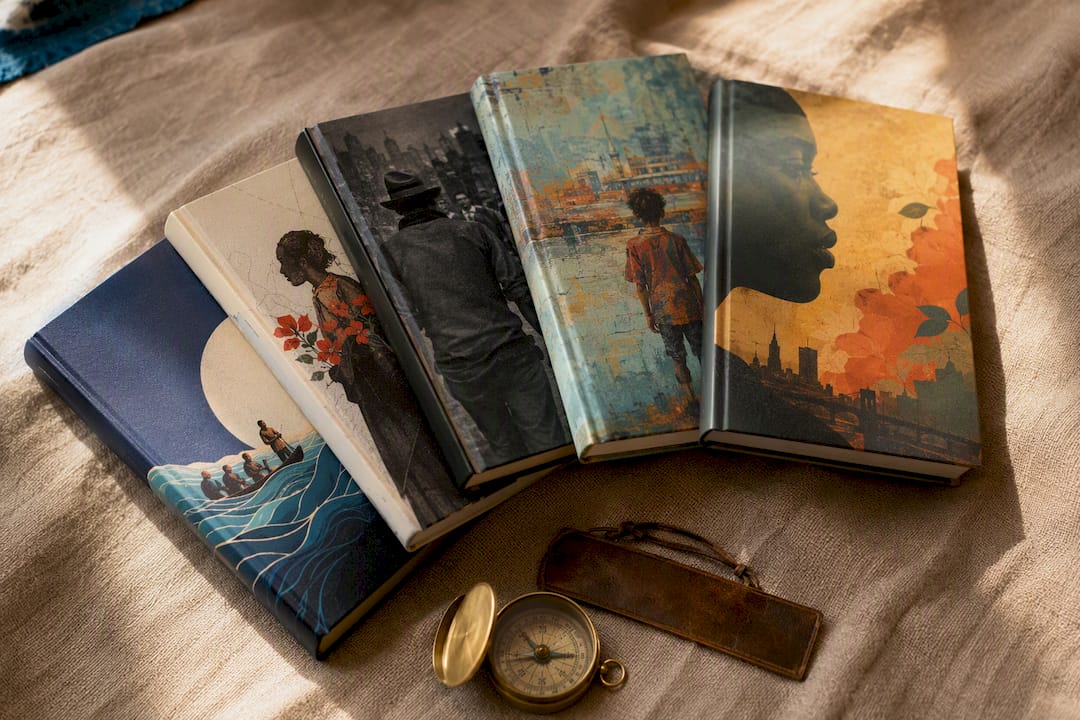
Structural risk has become almost its own category. A Visit from the Goon Squad’s PowerPoint chapter, Trust’s four contradictory narrators, and The Overstory’s tree-shaped plot show a jury willing to reward books that don’t behave like conventional novels. If you’re building a reading list around historical fiction winners specifically, a curated list of standout historical novels is a useful companion to the chronology above.
How the Pulitzer Compares to the National Book Award and the Booker Prize
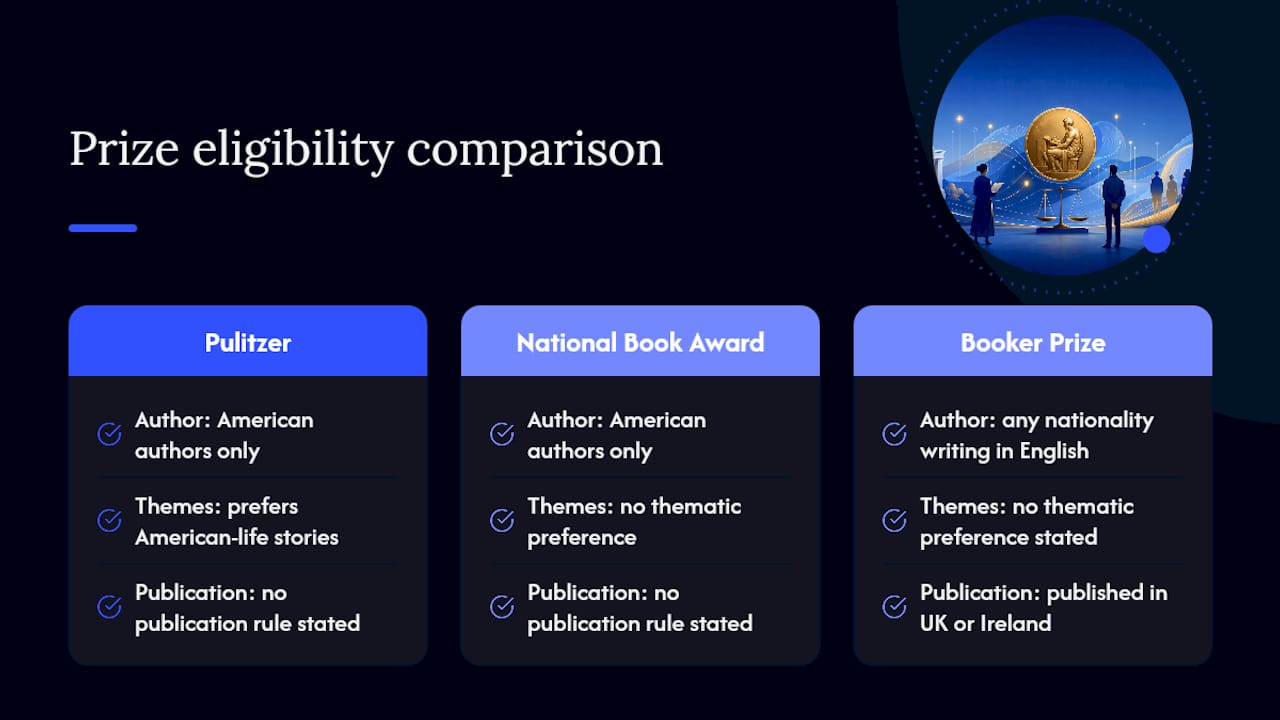
The Pulitzer, the National Book Award, and the Booker Prize often shortlist or crown the same books, but their eligibility rules diverge in ways that matter. The Pulitzer restricts eligibility to American authors, with a stated preference for stories dealing with American life. The National Book Award for Fiction shares that American-author requirement but carries no thematic preference at all. The Booker Prize, by contrast, is open to any novel written in English and published in the UK or Ireland, regardless of the author’s nationality, which is why it regularly crowns writers from Australia, Nigeria, or India in years the Pulitzer couldn’t touch.
The overlap shows up more than you’d expect. The Underground Railroad won both the Pulitzer and the National Book Award in the same year, a rare double. Beloved and Demon Copperhead both drew major recognition across multiple prizes in their respective years. When all three prizes converge on one book, it’s usually a strong signal the novel will still be read decades later. When they diverge, it often just reflects each prize’s different eligibility net rather than a disagreement about quality.
Where to Verify Every Winner and Finalist
Every entry in this list can be independently checked against a handful of primary sources, which is worth doing if you’re citing a winner for research or teaching.
- The Fiction category page on pulitzer.org lists every winner by year alongside that year’s finalists, straight from the organization that runs the prize.
- The prize winners by year index lets you cross-reference a specific year across every Pulitzer category at once.
- The Library of Congress’s NLS list of Pulitzer winners from 2000 onward is built for readers who want to request or download accessible editions.
- The Wikipedia summary of the Fiction prize is useful for historical context, no-award years, and citation trails back to primary reporting.
Where to Start If This List Feels Overwhelming
Ninety-six winners is a lot to face at once, so I’d start small: pick one decade above that already interests you, whether that’s the war fiction of the 1970s or the structural risk-takers of the last ten years, and read two or three from that stretch before jumping around. Pairing a winner with an author interview adds a layer you don’t get from the book alone; several past Pulitzer winners and finalists have appeared as guests discussing craft and process on The Bookaholic Podcast, and hearing a writer talk through their choices changes how the book reads afterward. Book-a-holic’s episode archive is a good next stop if you want that context alongside your reading list.
— Deirdre
Sources
- Fiction | The Pulitzer Prizes
- Daniel Kraus — The Pulitzer Prizes
- Percival Everett — The Pulitzer Prizes
- Pulitzer Prize for Fiction — Wikipedia
- Pulitzer Prize-Winning Fiction from 2000 — Library of Congress (NLS)
Recommended

Deirdre is a UNC Tarheel superfan and a proud member of Alpha Kappa Alpha Sorority, Inc., The Links, Incorporated, an associate member, and past regional officer of Jack and Jill of America, and a board member of Friends of the Gaston County Public Library. She is also a community advocate, world traveler, luxury handbag fanatic, wife, and mother of two adult sons.

40% Doubt Audiobooks Aren't Reading; Science and a Podcast Say Yes